The method — Conditions, then recognition
For nearly thirty years, my work has been in interactive museums and educational settings, designing exhibits and environments that visitors complete by moving through them — an experience made rather than an explanation given. I now turn the same methodology toward existential questions. The habit predates the code, a phenomenon set in motion and left to proceed. I learned to begin with a rough sketch, set it aside for a day, and return to it — and the judgment was always the same one. Not whether I had made the thing, but whether the thing could stand without me.
Working for Judy Pfaff, I came to understand a sculpture as something entered rather than viewed; in Edward Kienholz I found environments that are, before anything else, about a feeling — the room, or machine, as the carrier of an emotional state. What I build now is such a room, out of running code.
The agreement — Surrender
The Surrender Machines began as a question — can a machine surrender for us? I create the machines in worlds generated by image and text, or code; the machine surrenders on our behalf, and we recognize ourselves in what it returns. We build the votive, and we leave the votive behind, but we are the ones who started the process of the votive. We are still the composers.
Devotion — The votive
I think of each machine as a votive. In the Brazilian tradition, a votive is a devotional object — carved by your own hand or commissioned from a carver — that is then left behind in the church after serving its purpose. The machine holds what has been surrendered to it, and having held it, it is finished: it breaks, it scars, and it is left behind, its work done.
A technical object that fails — the aesthetic of the machine that wears and breaks, the teacup worth more once shattered, its cracks mended with gold. As a studio assistant to Donald Lipski, I learned that the assemblage of objects becomes larger than any single piece, and larger than the self that gathered them — a whole that outlasts both its parts and its maker.
Apparatus — The machine as subject
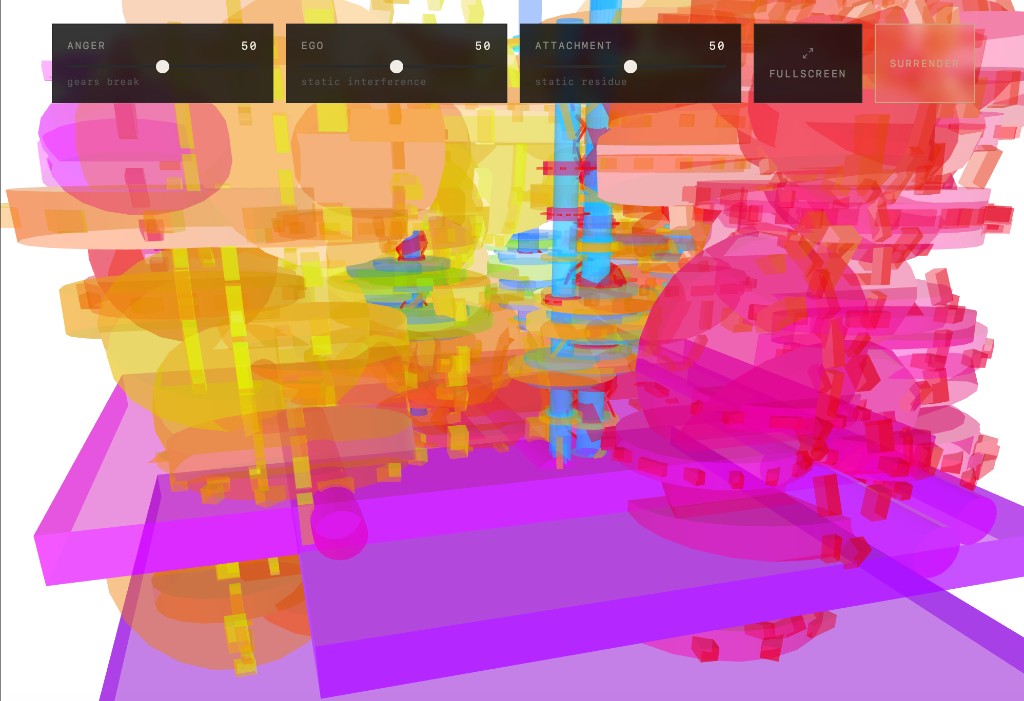
I wanted machines that move, not pictures of them. In code, a mechanism can be drawn in isometric or axonometric projection, given color, and set turning — a gear, a motor, an apparatus of no use to anyone. The reference is Alice Aycock’s orthographic drawings of impossible machines.
I do not hold the projections strict. Isometric and axonometric blur into one another because the code is indifferent to the distinction — hand it a plane and it renders depth regardless — and that indifference is the room I work in. A drafting convention built for precision becomes, in code, a loose and playable dimension.
Perception — Misreadings
Some of the work turns on the instant a thing is taken for something else. Waiting once in a slow apothecary in Macon, Georgia, I watched people enter and leave and saw a choreography in it, then wrote code that reproduces the dance. Walking home in Mexico another night, I raised a smartphone camera to the moon and found afterward it had been a satellite antenna on a roof — and made, from the error, an animation of a figure walking beneath a moon that is not one. Between these sit the mechanical drawings for emotions: feelings diagrammed in p5.js, three.js, Python, and openFrameworks, as though they were apparatus. It is here that the work achieves its intention: the moment a viewer looks at the machine and whispers unprompted that it looks like a ghost, only to realize an instant later — this is actually about me.
Agency — Ceding control
If the work is about surrender, it cannot keep authority for itself. Using Firebase and Netlify I let the audience’s phones drive what happens on screen, altering a single work at once — a condition I first admired in Leander Herzog’s Haystack.
The hidden field — The invisible layer
In game engines, terrain is not modeled in advance but summoned: a hidden field triggers geometry into existence as one moves through it, sparing the processor the cost of a world held all at once. Kim Asendorf’s Raster und Spektrum (2025) works this hidden field in two dimensions, as RGB. I remap it — RGB to XYZ — so that color becomes elevation and depth, and the concealed layer generates landscapes I have never seen.
The living system — One system, many bodies
Ágoston Nagy builds works in which sound and object are not made to react to one another but resolved into a single system — a state he calls sonification. The system’s own data voiced rather than only drawn, the same process heard as it is seen.
The body that carries this is deliberately plural — from a browser screen, to an LED object, to an immersive environment — an array of processors, panels, projectors, and actuators wired into one distributed organism, into which the code is placed without my knowing in advance what the organism will do. I resist letting such work collapse into recording; when a first exhibition in Madrid would accept only video files, the constraint only clarified the commitment. The pieces are made to run, not to be replayed, and they are kept live, with their working code, rather than filed away as footage.
Where it resolves — Machine DNA
All of it turns on the technical object — Gilbert Simondon’s proposition that a made thing possesses its own mode of existence, a life exceeding its maker’s intention — and on Gilbert Ryle’s ghost in the machine, inverted: the machine as an external reflection of us, held up until we are able to turn the reflection inward.
Machine DNA is the name for what this has become. A single kernel, a single genome, expressed across many bodies as one species rather than many copies. Its works break and scar, and the scars are gold and heritable — kintsugi, not reset. They witness, or they mirror, and they admit a viewer’s hand only where surrender and agency are themselves the subject. They age, seed, and die, so the work never hardens into a monument. It is not the generation of traits. It is acceptance, control, and agency, given a body and allowed to behave.
Formerly Emergent DNA · begun December 2025 · documented on objkt and Medium